How We Implement ACT, Disability-Affirmative Therapy, Trauma-Focused ACT & Why We Rarely Use EMDR
An in-depth clinical methodology guide for NHS commissioners, IRCM / BABICM / CMSUK case managers, Employee Assistance Programmes (EAPs), employers, and clients - explaining how our approach stabilises people when real-world disability triggers remain part of everyday life.

Core Clinical Aim: Stabilising Clients When Daily Triggers Never Disappear
A central misunderstanding in non-specialist counselling and commissioning is assuming therapy succeeds only when painful thoughts, physical symptoms, or distressing triggers are completely wiped out. For disabled, Deaf, and neurodivergent people, the triggers of everyday life with a disability are often ongoing - including chronic or neuropathic pain, fatigue, sensory overload, communication friction, inaccessible environments, medical appointments, or systemic discrimination.
Because those real-world triggers will always be there in some form, a "complete cure or total elimination of every trigger" is never a realistic or honest promise. Instead, our core aim with Acceptance and Commitment Therapy (ACT) and Trauma-Focused ACT (TFACT) is to stabilise clients: helping nervous systems settle, reducing emotional spiral and avoidance loops, and building practical, relevant coping skills tailored to the exact realities of the clients we see.
Rather than fighting normal reactions to ongoing challenges or forcing rigid symptom-elimination targets, stabilisation equips clients to respond flexibly, protect their energy and boundaries, and move forward toward what matters to them even while practical triggers remain part of life.
 Structured stabilisation and practical coping skills tailored to real-world daily realities.
Incorporating CBT Principles Into ACT
ACT is a third-wave cognitive-behavioural approach, and in our clinical work we incorporate CBT principles into ACT where they genuinely help - such as structured goal clarity, helpful behavioural routines, pacing, and noticing unhelpful thought traps - while shifting the emphasis away from arguing with or trying to "fix" every difficult feeling.
In non-specialist settings, standard CBT can sometimes feel invalidating when a person's distress is rooted in genuine pain flares, inaccessible services, communication barriers, or ongoing health uncertainty. By weaving CBT principles into ACT, clinicians help clients step back from unhelpful mental hooks (cognitive defusion), make room for uncomfortable emotions without getting swept away (acceptance), stay anchored in the present (present-moment awareness), see themselves as broader than a symptom or label (self-as-context), and take steady, values-guided steps (values & committed action) within realistic energy limits.
 Practical, values-led coping skills adapted to individual energy, sensory, and communication needs.
1. Practical Coping Skills Relevant to Each Client
Generic coping sheets rarely fit complex lives. We build concrete, usable skills around energy pacing, flare and fatigue recovery, sensory boundaries, communication fatigue, emotional regulation, and safe decision-making.
2. Stabilisation Before Deep Trauma Processing
Clients in acute overwhelm, crisis, or severe somatic/sensory strain work first on grounding, safety, and day-to-day stabilisation so therapy never pushes them past their capacity.
3. Values-Led Action Within Real Limits
Committed action is scaled to what is genuinely achievable and meaningful for that person - honouring health, access, and identity rather than imposing rigid ableist productivity standards.
Disability-Affirmative Therapy (DAT) & Complex Physical / Injury Care
Disability-Affirmative Therapy (DAT) grounds our ACT work in disability pride, identity validation, and an accurate understanding of how external barriers - such as inaccessible environments, ableism, audism, stigma, and fragmented care - interact with internal distress.
A person does not need to reject or "cure" their disability to experience emotional wellbeing. DAT helps distinguish between genuine clinical distress that therapy can help stabilise and rational protective responses to real-world barriers or ongoing physical/neurological conditions.
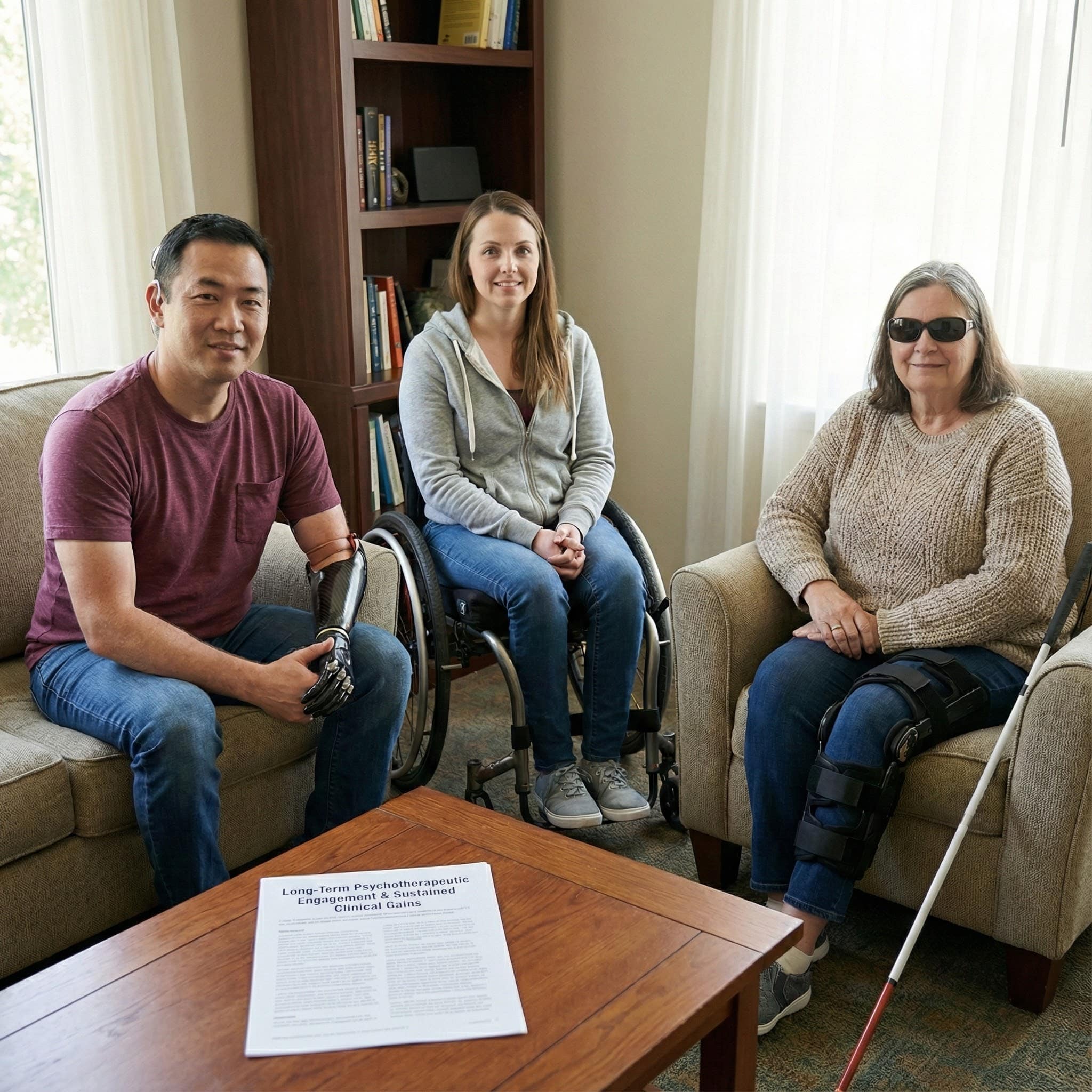
Across complex physical, neurological, and life-changing injury cases (including spinal cord injury, limb loss, brain injury, and progressive conditions), matching clients with clinicians who understand these realities - and adapting session length, pacing, eye-gaze/AAC communication, or bedrest access - prevents exhausting "disability education" and supports steadier recovery.
 Disability-affirmative practice tailored to complex physical, neurological, and injury realities.
How We Use Trauma-Focused ACT (TFACT)
Many clients carry medical trauma, ICU/hospital memories, sudden injury shock, childhood bullying, or discrimination alongside ongoing daily disability triggers. Trauma-Focused ACT (TFACT) combines present-moment grounding, self-compassion, unhooked memory work, and values-guided action so trauma memories feel less overwhelming and less controlling.
Crucially, TFACT respects that trauma in disabled and Deaf lives often sits alongside current, ongoing stressors rather than a single event safely locked in the past.
How and Why We Rarely Use EMDR
Although EMDR is widely known for single-incident trauma in non-disabled populations, we rarely use EMDR in our service. Standard eye-movement or rapid bilateral stimulation protocols can be clinically unsuitable, uncomfortable, or destabilising where a client has:
- Active, Ongoing Disability & Environmental Triggers: Ongoing pain, medical procedures, or daily barriers mean the threat is not simply "in the past".
- Sensory, Visual, Sign Language or Neurological Factors: Deaf BSL/ISL/visual communication, sight loss or visual strain, vestibular/balance sensitivity, seizure vulnerability, or high cognitive/autonomic fatigue.
- Need for Grounded Stabilisation First: TFACT and DAT allow clinicians to stabilise emotional regulation, identity, and practical coping skills first without triggering somatic or sensory overload.
Why ACT & DAT Work Well for Deaf and Autistic (ASD) Clients
Standard talking therapy models often misinterpret Deaf and Autistic (ASD) communication, sensory regulation, and protective routines. Our adapted ACT and Disability-Affirmative approach is well suited to both groups:
For Deaf Clients (Working Alongside Deaf4Deaf ): Delivered directly 1-to-1 in fluent BSL, ISL, or captioned/adapted communication without an interpreter. Clinicians understand Deaf culture, communication history, and visual safety habits (such as checking locks or appliances visually) rather than mislabelling them as pathology, while building practical coping skills for everyday barriers.
For Autistic (ASD) Clients (Aged 16+ & Adults): Supported by dedicated male and female specialist ASD Psychotherapists (no formal diagnosis required for self-paid or workplace routes). Rather than forcing neurotypical eye contact, masking, or rigid thought-challenging, ACT and affirmative practice support sensory boundaries, autistic burnout recovery, executive overwhelm, and values-led living.
 Adapted to Deaf communication, sensory needs, and Autistic (ASD) ways of processing the world.
| Referrer / Commissioner | How Our Methodology Delivers Value |
|---|---|
| NHS Commissioners & GPs (16+) | Targets complex "Missing Middle" and disability/Deaf mental health needs where generic short-term CBT often stalls, using structured stabilisation, calibrated outcome tracking, and clear clinical reporting. |
| Case Managers & Solicitors | Aligns with rehabilitation goals by stabilising trauma, pain, and adjustment distress early - helping clients engage quicker, reducing the number of sessions needed, and lowering overall total counselling charges. |
| EAPs & Employers | Provides practical workplace coping and resilience strategies alongside Equality Act 2010 accessibility (including direct BSL and neurodiversity-informed support), avoiding false-economy delays or mismatched referrals. |
Self-Refer (Client or Carer)
Start heavily subsidised self-paid sessions (£50 first session), check NHS options (16+), or ask about Access to Work.
Ask Us a Question
Want to check if ACT, TFACT, or DAT fits a specific client or pathway? Message our team.
Professional Referrals
Direct referral form for Case Managers, Solicitors, EAPs, Employers, HR, Schools, Colleges, Universities & Charities.
GP & NHS Referrals
Direct referral portal for Primary Care GPs, NHS Talking Therapies teams, Welsh Health Boards, and ICBs.